


What the Latest UK Vacancy Headlines Mean for Automotive

Share this Page



Recent headlines about a sharp fall in UK job vacancies have reinforced the idea that the labour market is entering a more cautious phase. National data shows vacancies at their lowest level since 2021, with employers becoming more selective and competition for roles increasing.
But when we compare those wider trends with the latest IMI Vacancy Tracker for January 2026, a more nuanced picture begins to emerge, particularly for automotive.
A cooling market — but not a collapsing one
There’s no doubt the wider UK labour market is slowing. Economic uncertainty, changing business confidence and rising operating costs are influencing recruitment decisions across many sectors.
Yet automotive tells a slightly different story. While the number of open roles has eased compared with the peaks seen in 2024 and early 2025, the sector’s vacancy rate remains above the national average.
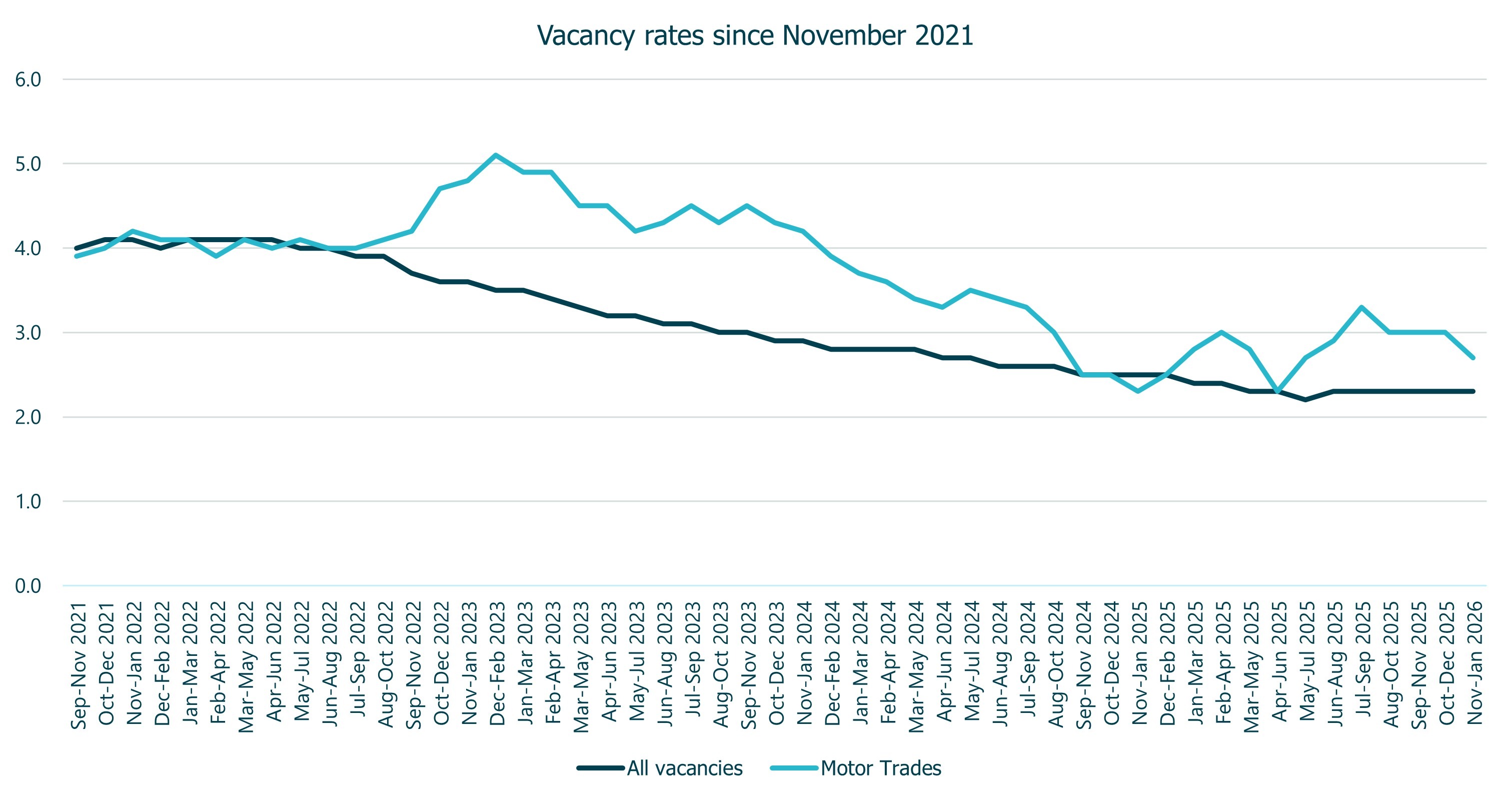
The chart above highlights the core dynamic shaping today’s labour market narrative. Vacancy rates have declined steadily across the UK as a whole, but motor trade vacancy rates remain consistently higher than the all-industry average.
That distinction matters. Automotive employers are not stepping back from hiring altogether. Instead, the data suggests they are recalibrating. We’re seeing a shift away from volume recruitment towards more targeted hiring focused on critical technical and operational skills.
From labour shortage crisis to structural skills challenge
National headlines risk creating the impression that labour shortages are easing across the board. Automotive data suggests otherwise.
Even as total vacancies reduce, employers continue to report difficulty filling skilled technical roles – particularly those requiring workshop-ready experience, diagnostic capability or multi-skilled expertise.
In many ways, the sector appears to be moving from a post-pandemic “vacancy surge” into a more structural phase of skills pressure. As the broader labour market cools, long-standing skills mismatches are becoming more visible.
Rather than competing for large volumes of candidates, employers are increasingly competing for specific capabilities aligned to electrification, digitalisation and evolving vehicle technologies.
Recent trend analysis reinforces this shift. Automotive vacancy demand is cooling more sharply than the wider economy. While UK-wide vacancy growth has eased gradually, year-on-year changes in automotive vacancies have turned negative more quickly.
This suggests a move away from expansion-driven hiring towards a more focused, strategic approach centred on critical technical roles. Importantly, this appears to be a recalibration of hiring strategy, not a contraction in the underlying workforce need.
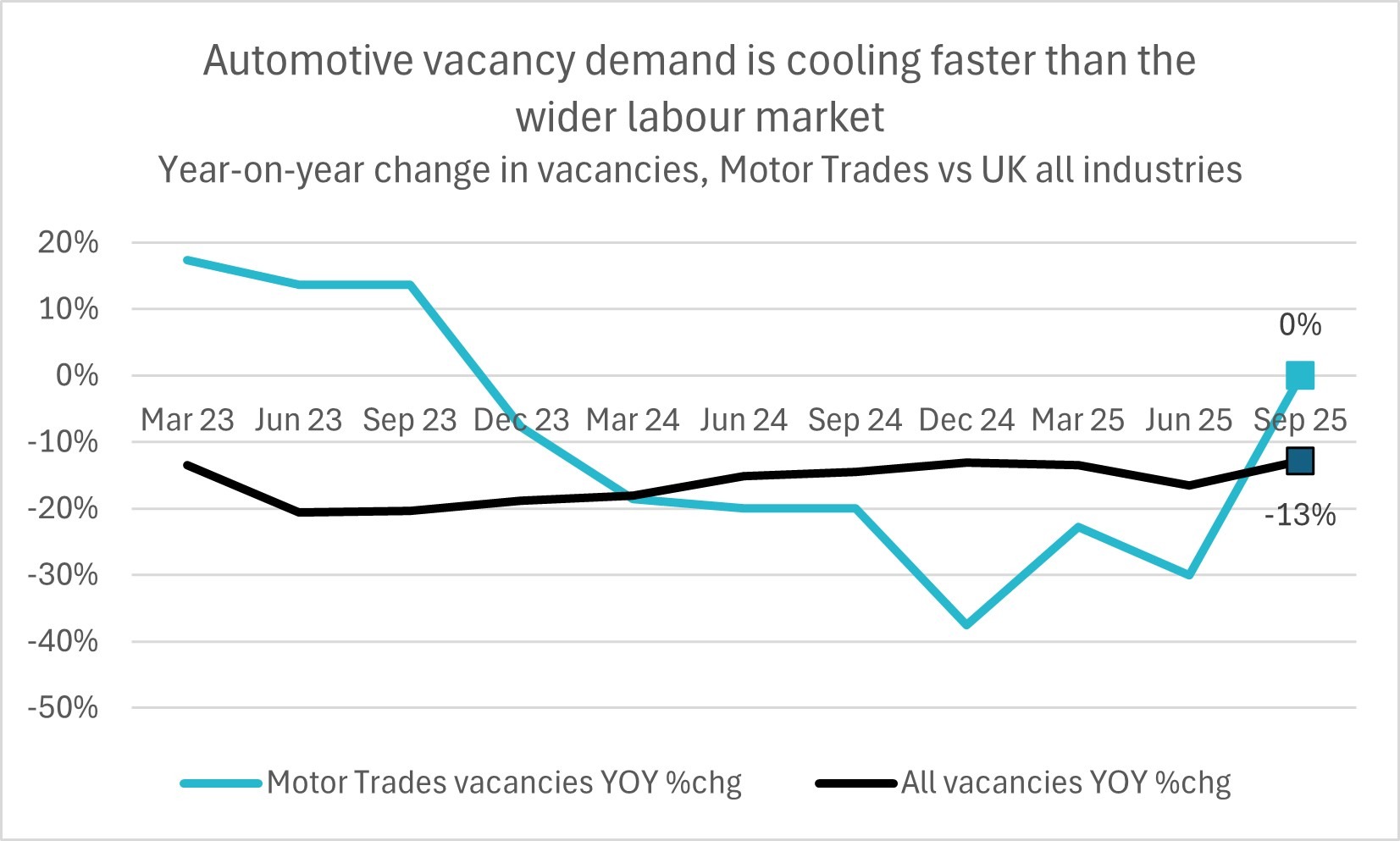
The year-on-year view adds another layer of insight. Automotive vacancy growth has softened faster than the national trend, underlining the point that employers are becoming more selective – not withdrawing from recruitment. It reflects a sector transitioning from rapid post-pandemic expansion to a more stable, but still skills-constrained, environment.
Why the comparison matters
Looking at automotive data alongside national vacancy trends highlights three key insights:
Resilience despite economic cooling - Automotive hiring is easing in line with wider economic conditions, but it remains comparatively strong. Recruitment pressure is still higher than the UK average, signalling ongoing structural demand for skilled labour.
A shift towards targeted recruitment - Employers are prioritising quality of skills over quantity of roles. This reflects both economic caution and the increasing technical complexity of modern automotive jobs.
Greater visibility of skills gaps - As overall vacancies fall, sectors with persistent shortages stand out more clearly. Automotive continues to demonstrate long-term workforce challenges rather than short-term cyclical ones.
Implications for employers and policymakers
For employers, the changing landscape reinforces the importance of retention, progression and workforce development. Relying solely on external recruitment will not be enough. Investment in upskilling, apprenticeships and clear internal career pathways will be critical as hiring becomes more selective.
For policymakers, the comparison underlines why sector-specific insight matters. National vacancy figures alone cannot fully capture the structural challenges facing industries undergoing rapid technological transition.
Even in a cooling labour market, automotive continues to require targeted skills investment, support for retraining and policies that enable the workforce to adapt to future technologies.
A changing narrative for 2026
The key takeaway is not that labour shortages have disappeared. It’s that they are evolving.
The UK labour market may be moderating, but automotive employers remain under pressure to secure the technical skills needed to support the sector’s transformation.
Understanding this distinction will be crucial in shaping workforce strategy, policy decisions and industry messaging over the coming year. The latest vacancy trends do not signal the end of skills challenges. Instead, they point to a more complex and targeted phase of labour market demand – one where having the right skills matters more than ever.