


Industry leaders and Shadow Secretary of State for Transport unite to call for mandatory TechSafe standards across UK automotive sector
 3 mins read time
 Policy
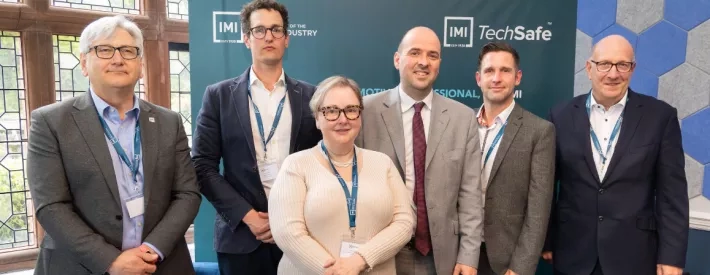
Consensus reached at IMI-hosted policy panel discussion that government must act to ensure safety-critical competence across key vehicle technology areas
The Institute of the Motor Industry (IMI) brought together senior industry figures on Thursday 14th May 2026 for a high-level policy panel session and discussion focused on the future of automotive workforce safety. Convened by IMI CEO, Nick Connor, the event was attended by Shadow Secretary of State for Transport, Rt Hon Richard Holden MP, alongside an expert panel of employers, legal professionals, fleet operators and academic researchers.
The meeting produced a clear and unified message: as vehicles become increasingly complex technology platforms, government must act to ensure the people maintaining, repairing, diagnosing, and recovering them hold demonstrable, auditable competence for consumer confidence and road safety. The IMI’s TechSafe standard was identified as the practical mechanism to deliver this, with participants calling on government to mandate its use across four rapidly evolving areas of the automotive sector:
• Connected vehicles – covering data integrity, cybersecurity hygiene, software updates and over-the-air interactions
• Automated vehicle technology – including ADAS, sensors, radar, lidar, calibration, and in-use safety assurance
• Electric vehicles (EV) – covering high-voltage isolation, battery health, thermal management and power electronics
• Alternative fuels – hydrogen, gas and other non-conventional energy systems, including storage, containment and emergency response
“The automotive sector is undergoing the most significant period of change in its history with electrification, connected vehicles, autonomous driving, alternative fuels and new digital systems reshaping not only the vehicles on our roads, but the skills, standards and responsibilities required of the workforce,” explained Nick Connor, CEO of the IMI. “It is now a question of public safety, consumer confidence, economic growth and industrial readiness that workforce competence is at the heart of automotive-specific regulation.
“IMI TechSafe is already recognised as the practical mechanism to audit workforce competence. It could, therefore, be the right solution to help government, industry and the public manage the risks and opportunities of new vehicle technologies.”
Rt Hon Richard Holden, MP added: “It was great to speak to the IMI, which is doing vital work to shine a torch on this growing regulatory gap. As vehicles become more technologically advanced, consumers, insurers and the wider industry all need confidence that the people repairing and maintaining them have the right skills and training. Recognised standards like IMI TechSafe can play an important role in building that trust and helping ensure safety keeps pace with innovation.”
Underlining the urgency for a solution to ensure both the automotive workforce and UK road users remain safe was the current state of EV qualifications in the automotive sector. The latest IMI TechSafe data shows that just over a third of technicians have some level of qualification to work on electric vehicles. However, whilst forecasts show continued growth in EV certification over the next decade, projected demand continues to rise at a faster rate as employers remain unsupported to commit to this critical training whilst also facing serious recruitment pressures.
Several other key issues currently impacting the automotive sector were also discussed by the panel:
• The role of independent garages, specialist repairers and recovery operators is critical to UK road safety - for technicians operating outside of franchised networks, demonstrable professional recognition is especially important to inspire consumer confidence.
• As vehicles on UK roads carry an increasingly diverse mix of technologies, technicians must be equipped to work competently across all of them, rather than being siloed by fuel or energy type. Any competency standard must, therefore, be drive-train neutral – supporting a workforce that is genuinely ‘omnicompetent’ and able to operate safely across evolving technologies, regardless of powertrain type.
• A foundation of core competencies across the sector must be maintained and strengthened as technology advances.
The opportunity for change: Automated Vehicles Act 2024
Event participants identified the ongoing implementation of the Automated Vehicles Act 2024 as an immediate and practical policy hook for mandating of TechSafe. The Act creates the framework for authorised entities and in-use assurance. The IMI is, therefore, calling on government to use the Act’s secondary regulations and statutory guidance to specify the evidence expected when safety-critical work is carried out on automated and connected vehicles, and to embed TechSafe within that framework.
“The risks associated with modern vehicle technology do not end at the point of manufacture – they continue throughout the full life of the vehicle,” added Nick Connor. “Repair, servicing, diagnostics, software updates, battery health management, recovery, resale and end-of-life processes all carry safety-critical implications when handled by those without the right competence.
“Consistent professional standards and independent recognition are essential not only to protect technicians and the public, but to underpin consumer confidence in new vehicle technologies. And that is vital for the government’s net zero ambitions. Motorists should have clear assurance that the person working on their vehicle is appropriately trained, current and accountable – and government policy should make that assurance possible.”
Other panellists at the discussion were
• Matt Cleevely AAE MIMI - Managing Director, Cleevely Electric Vehicles
• Dr Louis Lines - Research Fellow, Cardiff University
• Nona Bowkis - Head of Legal Services / Solicitor, Lawgistics
• Vincent St Claire - Managing Director, Fleet Assist

The IMI
Share this Page