


Vacancy Tracker - March 2026
 4 minute read time
 Labour Market
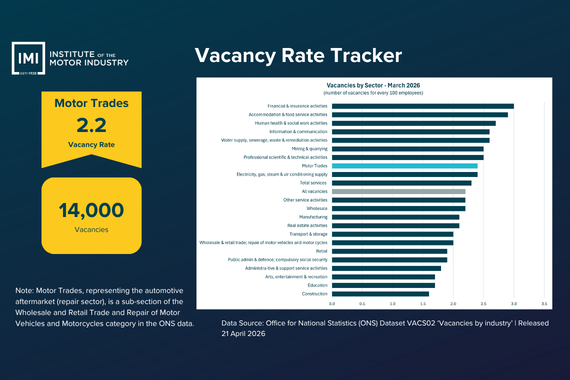
Each month, we analyse UK job vacancy data from the Office for National Statistics (ONS) to to track recruitment pressure in the Motor Trades sector.
Motor trade vacancies increased to 16,000 in January to March 2026, up from 14,000 in the previous period. The vacancy rate also rose to 2.4 vacancies per 100 employees, compared with 2.3 in December to February.
Although vacancy levels remain below the highs recorded in 2025, this month’s increase suggests recruitment activity may be starting to stabilise.
Motor trade vacancy levels increased in March 2026, contrasting with the wider slowdown in UK hiring and suggesting demand for skilled workers remains resilient.
Across the wider labour market, vacancies continued to decline. Total UK vacancies fell to 710,000, while the overall vacancy rate remained at 2.2.
Automotive vacancies: March 2026 at a glance
- Vacancy rate: 2.4
- UK industry rank: 8 out of 23
- Approximate open positions: 14,000
- Year-on-year change: -17%
- Two-year change: -38%
Motor trade vacancies rose after several months of decline. While demand remains lower than earlier peaks, the sector continues to perform slightly above the UK average.
Vacancy rates over time
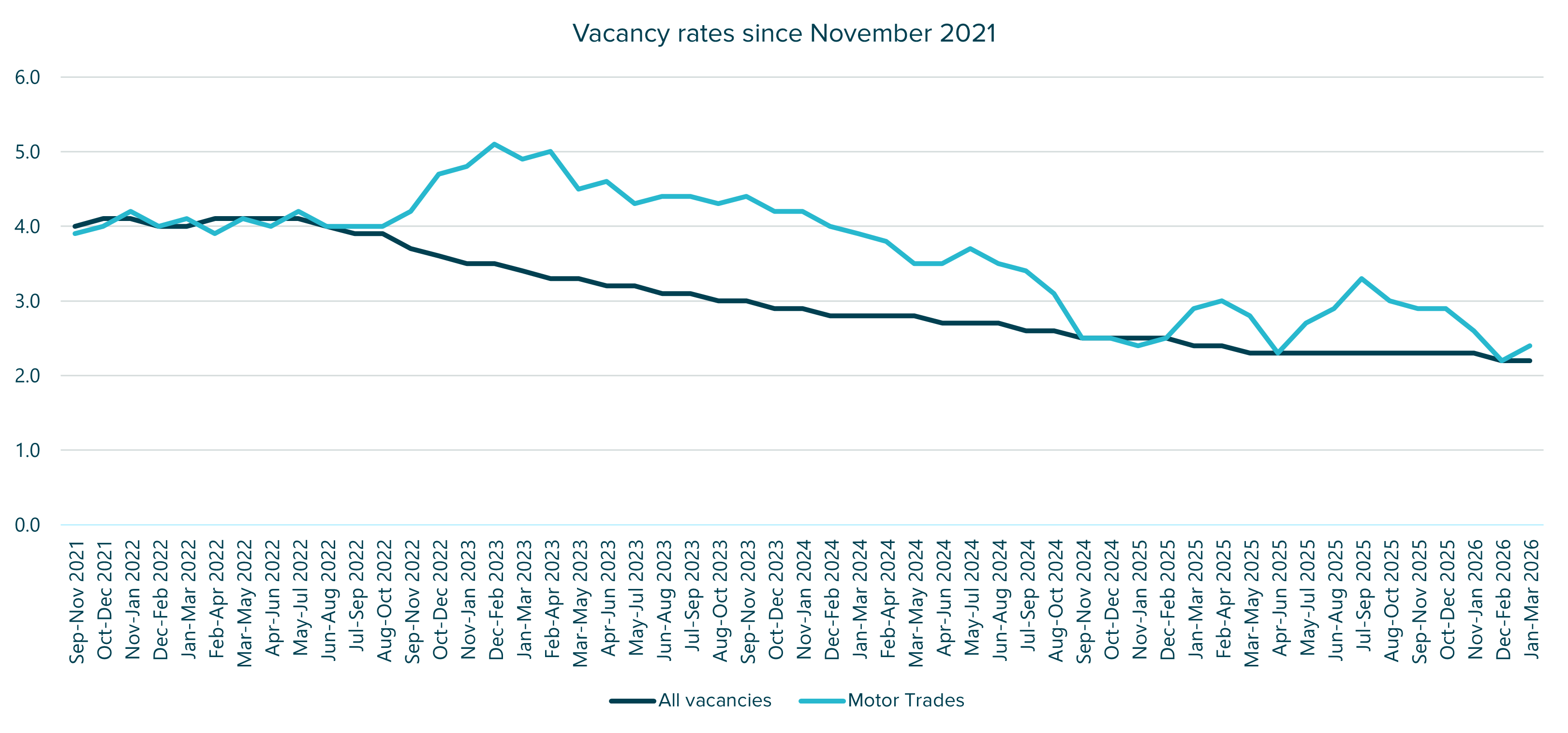
Motor trade vacancy rates have generally trended down since early 2023, although the latest figures point to a modest recovery.
The vacancy rate increased from 2.3 to 2.4 in the latest period. Over the same timeframe, the UK average remained stable at 2.2.
This suggests the sector may be recovering more quickly than the wider labour market, despite overall hiring remaining subdued.
Wider UK vacancy picture
UK vacancies continued to fall during the latest reporting period, declining from 832,000 in mid-2024 to 710,000.
The broader labour market remains cautious. Employers are advertising fewer new positions, and vacancy growth has slowed across most sectors.
Vacancies by sector
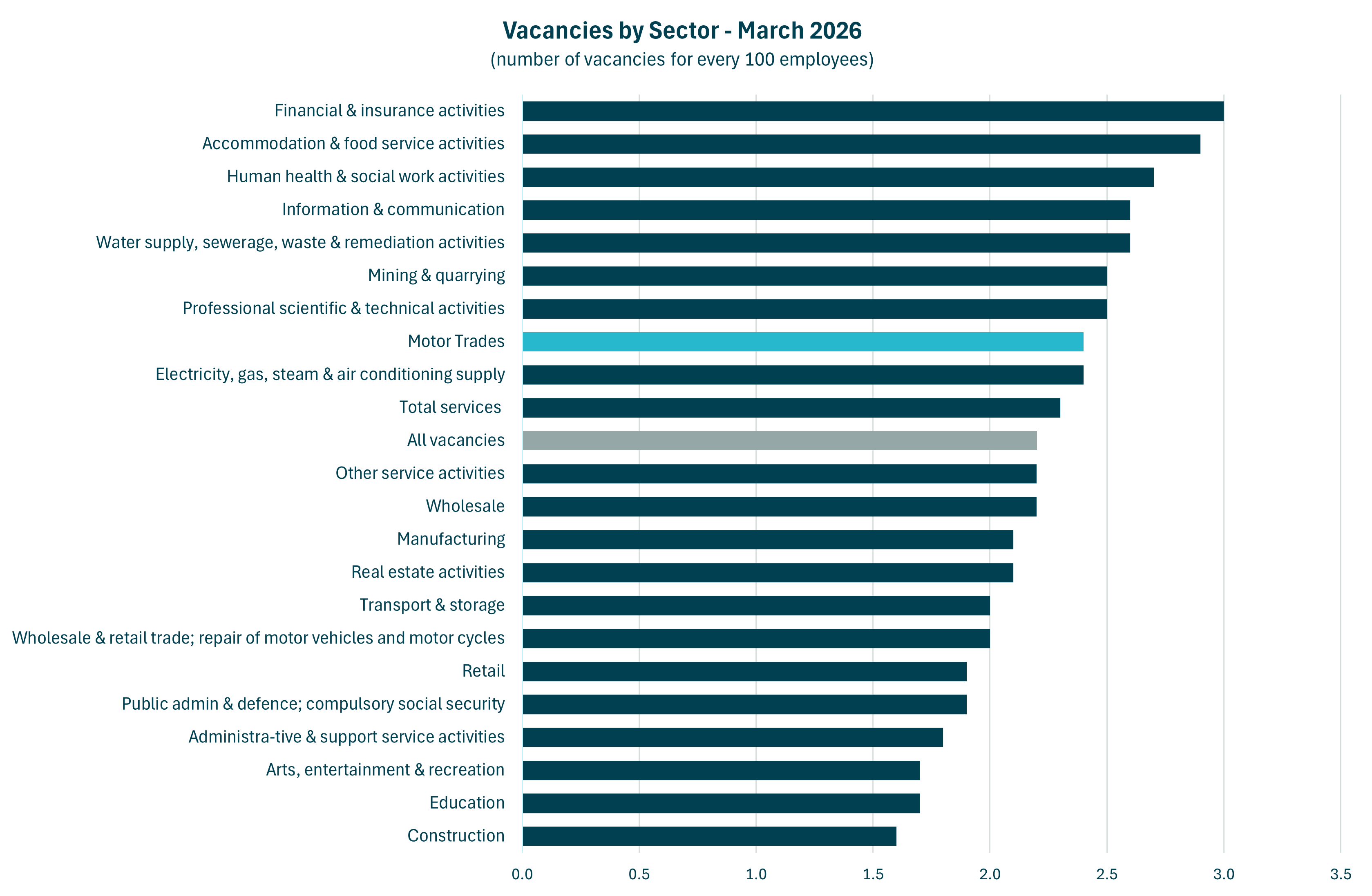
Motor trades recorded 2.4 vacancies per 100 employees, placing the sector slightly above the UK average.
Industries including finance and accommodation and food services continue to report stronger vacancy rates, while construction and education remain lower.
The sector also rose in the industry rankings compared with the previous period, indicating stronger relative demand than in recent months.
Vacancy posting behaviour
Online job postings suggest recruitment activity improved slightly in early 2026 after slowing towards the end of 2025.
Employers appear to be maintaining recruitment for essential operational roles, while remaining cautious about wider expansion.
Skills demand
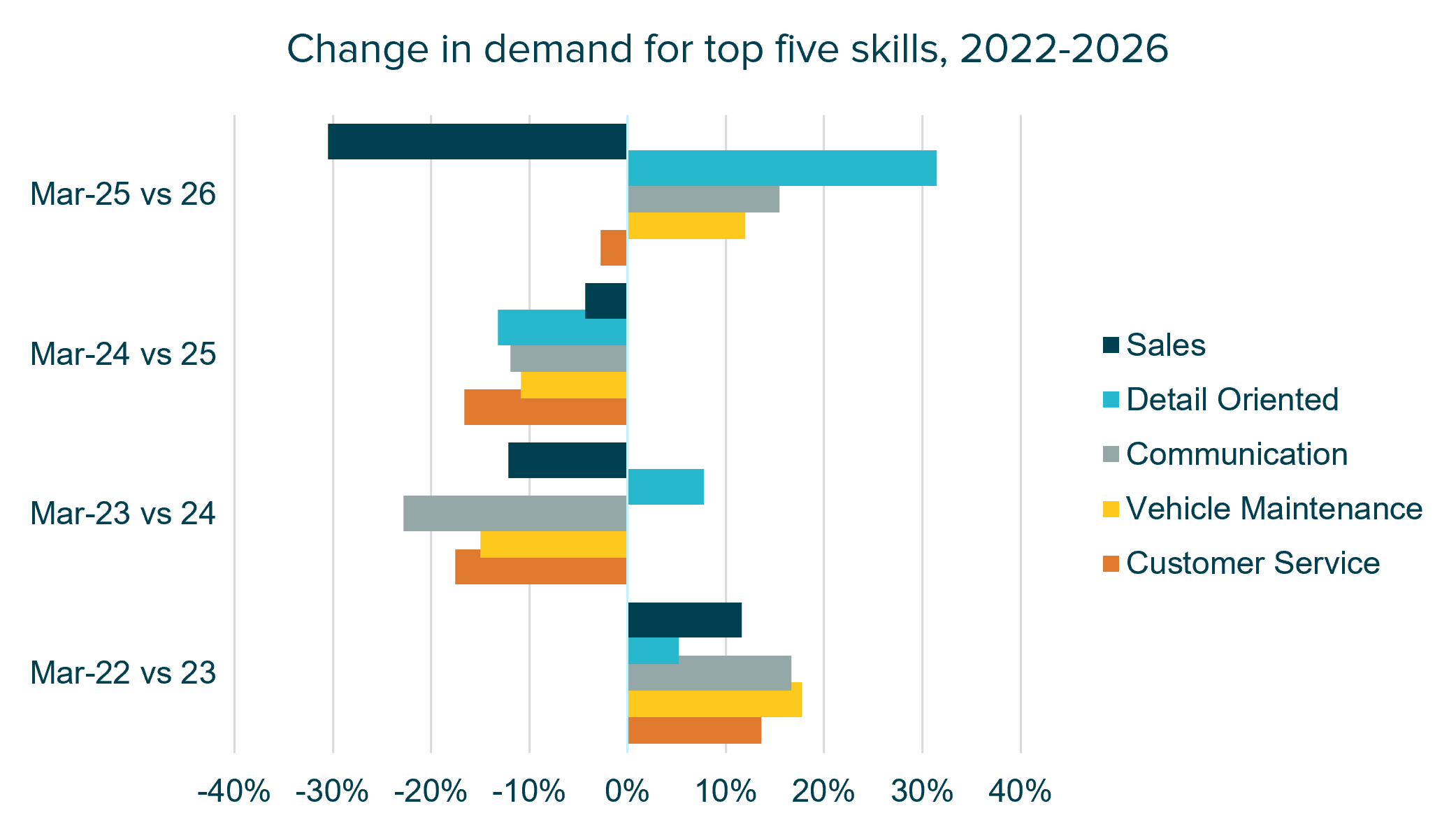
The strongest growth in the latest period came from skills linked to vehicle inspection, diagnostics, and workshop operations. Vehicle inspection (+29%), detail oriented skills (+31%), and organisational skills (+51%) all increased, alongside growth in mechanics (+20%) and suspension (+20%).
This suggests employers continue to prioritise servicing, repair, and maintenance capability as workshops focus on efficiency, diagnostics, and vehicle safety.
By contrast, customer-facing and management-related skills weakened. After sales support (-44%), sales (-30%), and management (-21%) all declined in the latest period.
Overall, the data suggests employers remain focused on filling core technical and workshop-based roles, while recruitment demand for customer-facing and supervisory functions has softened.
Occupational demand
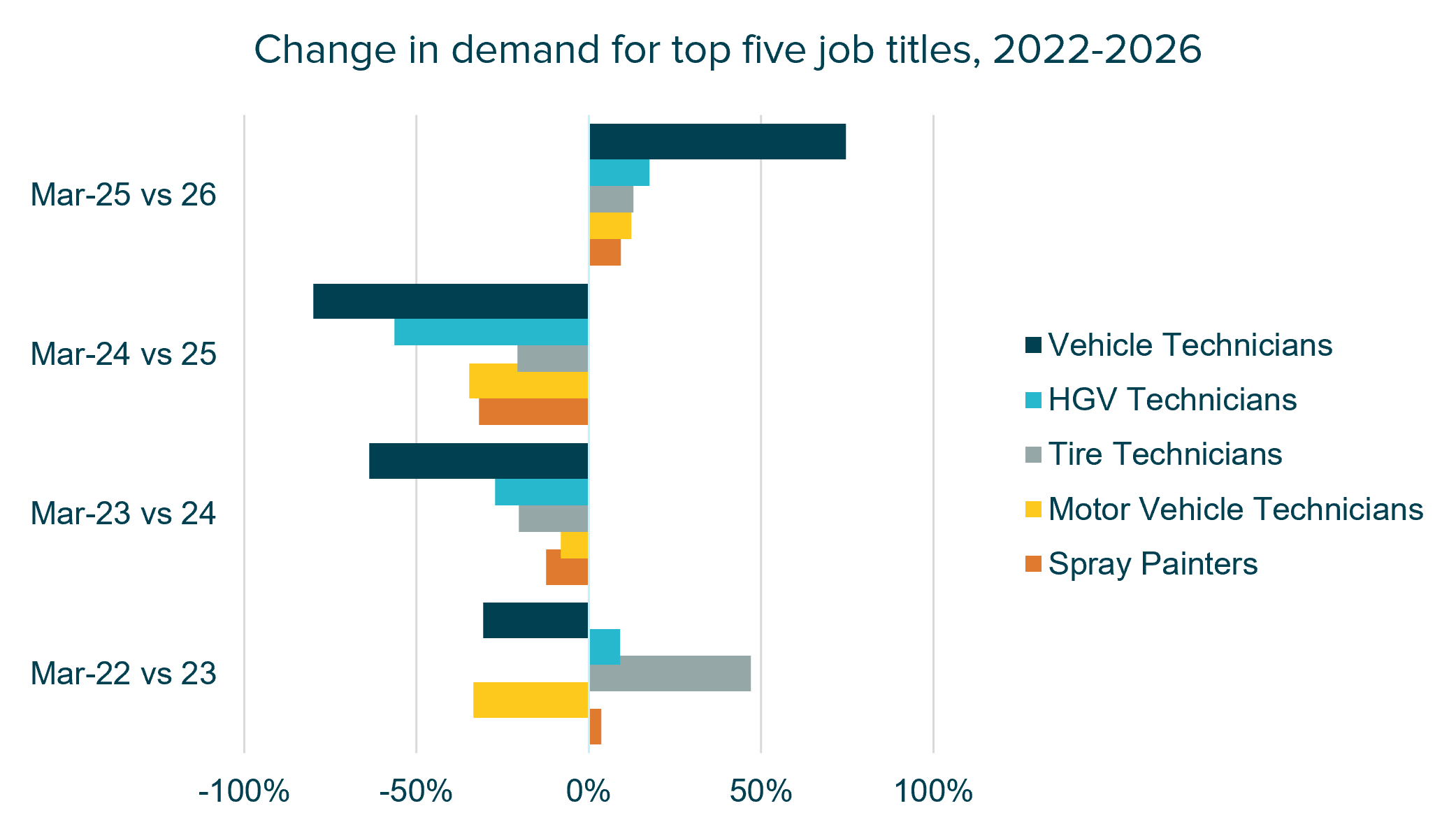
Demand across automotive occupations remains mixed.
- Vehicle technician roles are now the largest area of demand and reversed the decline reported in recent months (+74%).
- HGV technician roles recorded strong year-on-year growth compared with March 2025 (+18%), reflecting ongoing skills gaps
- Job titles linked to apprenticeships fell sharply (-59%), supporting earlier IMI reporting on apprenticeship pressures.
Other automotive occupations weakened. Testers (-25%), valeters (-18%), and mobile managers (-41%) all recorded lower demand than a year ago, suggesting employers are focusing recruitment on core servicing, repair, and maintenance capability rather than wider operational support roles.
Employers continue to recruit for essential technical roles, although hiring volumes remain below levels seen during the post-pandemic recovery period.
Key takeaways
- Motor trade vacancies were 14,000 in the latest period
- The vacancy rate rose to 2.4, above the UK average
- Wider UK vacancy levels continue to decline
- Technical and maintenance roles are the strongest areas of demand
- Employers continue to recruit cautiously, with focus on operational capability
Data sources
This report combines vacancy data from the Office for National Statistics (ONS) with online job advertisement data from Lightcast.
Vacancy rates represent vacancies per 100 employee jobs. Lightcast data reflects online recruitment activity and may not capture all vacancies.
Author: Angela Barnard, Research and Insights Analyst.


The IMI
Share this Page