


Vacancy Tracker - February 2026
 7 minute read time
 Labour Market
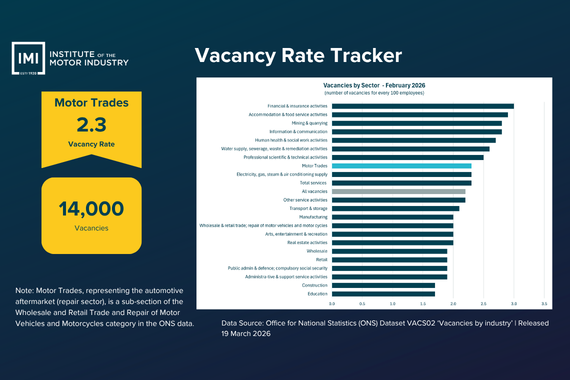
Each month, we analyse UK job vacancy data from the Office for National Statistics (ONS) to to track recruitment pressure in the Motor Trades sector.
Motor trade vacancies fell to 14,000 in December to February 2026, down from 15,000 in the previous period. The vacancy rate also declined to 2.3 vacancies per 100 employees, matching the lowest level seen over the past 18 months.
This confirms that recruitment demand in the sector continues to ease, in line with the wider UK labour market.
Motor trade vacancy levels continue to fall, reflecting a broader slowdown in UK hiring, but demand remains slightly above the national average.
The wider labour market also shows a steady decline. Total vacancies fell to 721,000, with the overall vacancy rate at 2.2.
Automotive vacancies: February 2026 at a glance
- Vacancy rate: 2.3
- UK industry rank: 8 out of 23
- Approximate open positions: 14,000
- Year-on-year change: -7%
- Two-year change: -39%
Motor trade vacancies have edged down in recent months, following a brief rise in mid-2025. The sector remains slightly above the UK average, which suggests demand for skilled workers is still relatively resilient.
Vacancy rates over time
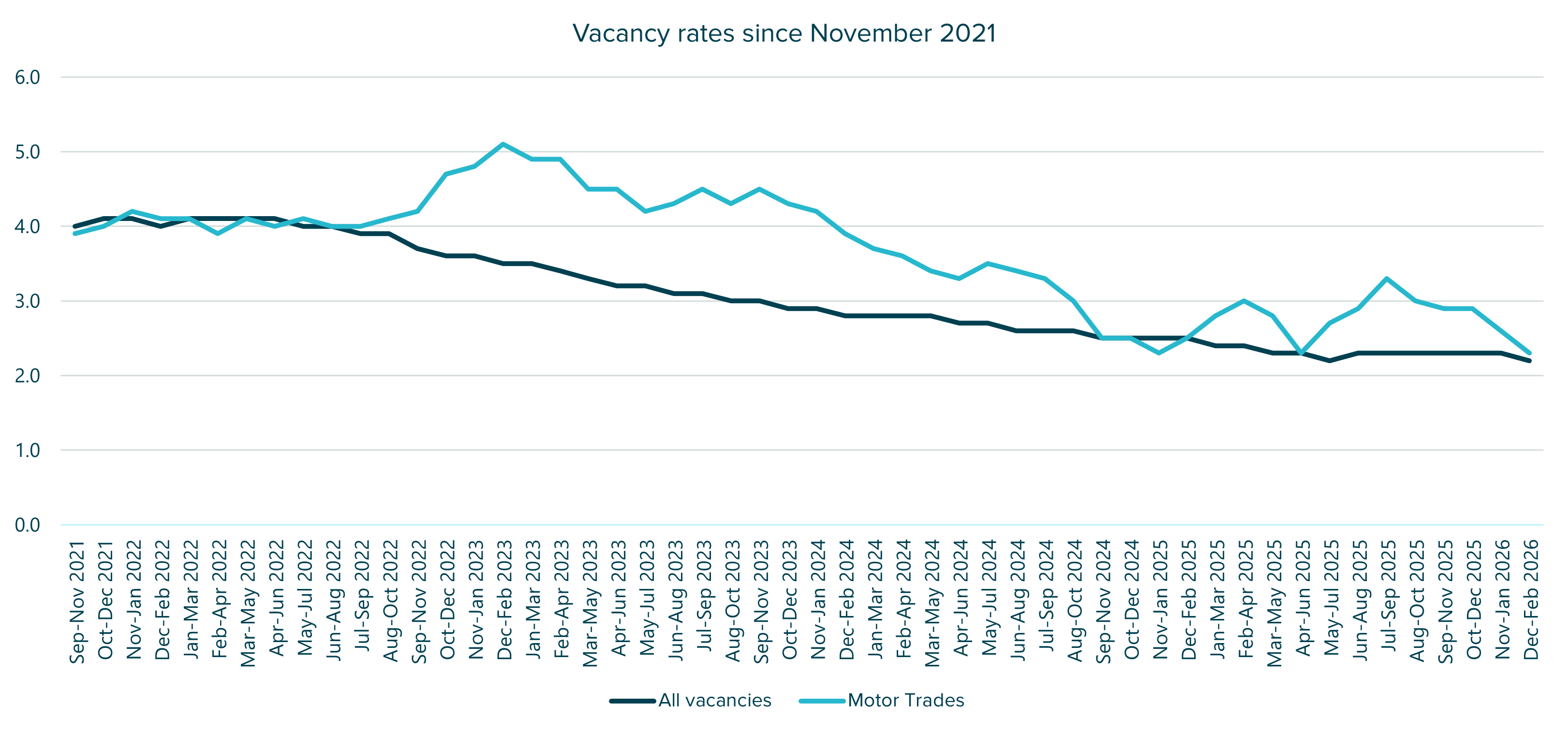
Vacancy rates in motor trades have followed a clear downward trend since early 2023, with short periods of recovery.
The rate peaked at 3.3 in July to September 2025 before falling steadily to 2.3. Over the same period, the UK average declined more gradually, from 2.6 to 2.2.
This gap shows that demand in motor trades remains slightly stronger than the wider labour market, despite the overall slowdown.
Wider UK vacancy picture
Across all sectors, vacancies fell from 832,000 in mid-2024 to 721,000 in the latest period.
This sustained decline points to a cooling labour market. Employers are posting fewer roles and filling positions more slowly.
Vacancies by sector
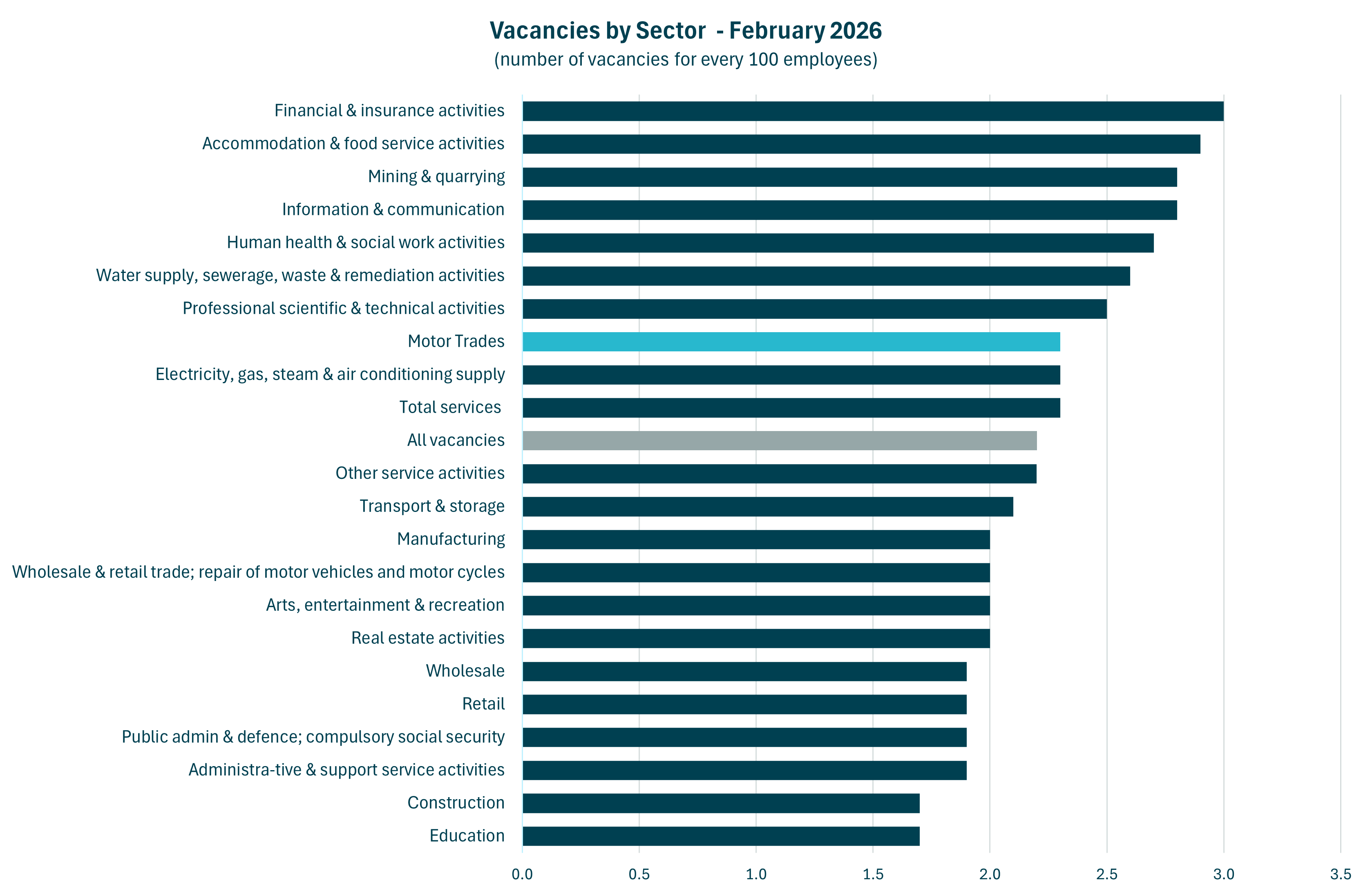
Motor trades recorded 2.3 vacancies per 100 employees, placing the sector around the middle of the UK industry ranking.
Sectors such as finance and hospitality report higher vacancy rates, while education and construction remain lower.
This shows that motor trades demand is moderate relative to the wider economy, rather than leading or lagging.
The sector also fell five places in the rankings compared with the previous period, indicating a relative weakening against other industries.
Vacancy posting behaviour
Online job postings show a mixed picture. Hiring activity rose in parts of 2025 but has since slowed.
Employers are posting fewer new roles, and recruitment activity appears more stable. This aligns with trends in official vacancy estimates.
Skills demand
Demand for core technical skills has eased, with clear shifts across the period.
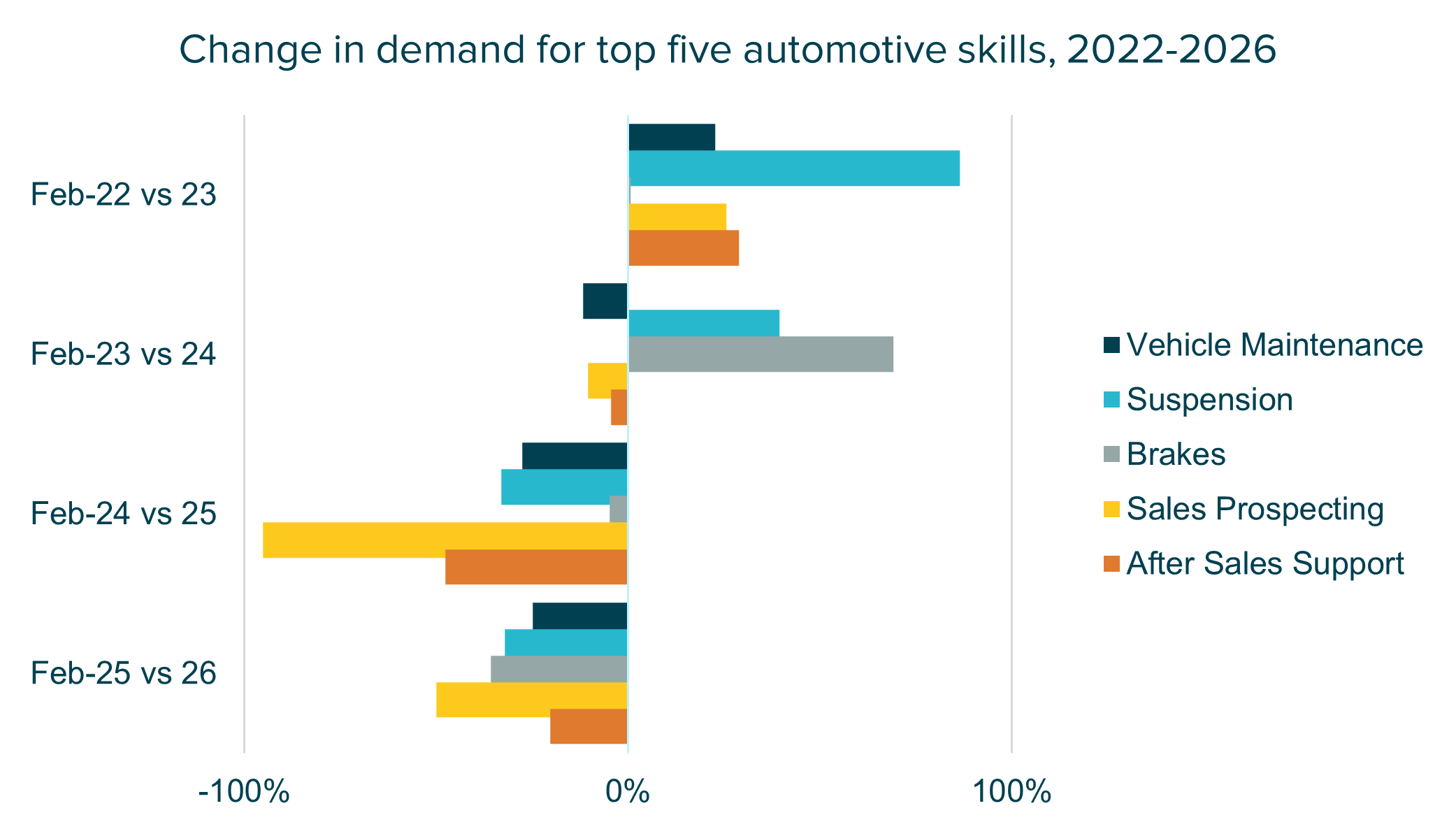
Demand rose strongly in 2022 to 2023, led by suspension (+86%), with steady growth in vehicle maintenance and after sales support.
In 2023 to 2024, the picture became more mixed. Braking skills (+69%) increased, while vehicle maintenance (-12%) and after sales support both declined.
Demand then fell sharply in 2024 to 2025 across all five skills. The steepest drops came in sales prospecting (-95%) and after sales support (-48%), alongside declines in technical areas.
The latest period shows continued falls. Brakes (-36%), suspension (-32%), and vehicle maintenance (-25%) all declined again, while sales prospecting (-50%) remains well below earlier levels.
These trends reflect weaker hiring demand rather than a shift in underlying skill needs.
Occupational demand
Demand has fallen across most automotive occupations since 2024.
- Vehicle technicians and mechanics remain the largest area of demand but have declined
- Sales roles show one of the steepest drops
- Specialist roles, such as paint technicians, fluctuate but remain below earlier levels
This indicates a shift towards essential maintenance roles, with less emphasis on sales-driven activity.
Employers continue to recruit for core technical roles, but at lower volumes, with demand concentrated on essential maintenance rather than sales activity.
Who is hiring
Recruitment activity remains spread across independent garages, franchised dealers, and large service chains.
Although hiring volumes are lower than in 2024, employers continue to recruit for skilled technical roles.
Evolving role
The automotive workforce continues to shift towards technical capability.
Employers increasingly seek workers who can handle diagnostics, electric vehicles, and integrated systems. This increases demand for training and upskilling.
Key takeaways
- Motor trade vacancies fell to 14,000, continuing the downward trend
- The vacancy rate dropped to 2.3, close to the UK average
- The wider labour market continues to cool
- Demand has weakened across both technical and sales skills
- Employers still need skilled workers despite lower vacancy levels
ONS vacancy estimates come from the UK Vacancy Survey rolling quarterly series. Online job advert and skills insights come from Lightcast, which analyses job postings to track hiring trends and skill demand across the UK economy.
Author: Angela Barnard, Research and Insights Analyst.


The IMI
Share this Page